

Nonprofit Contract Management for Grants and Compliance
Jørgen Højlund WibePublished July 21, 2026Updated November 9, 20266 min read
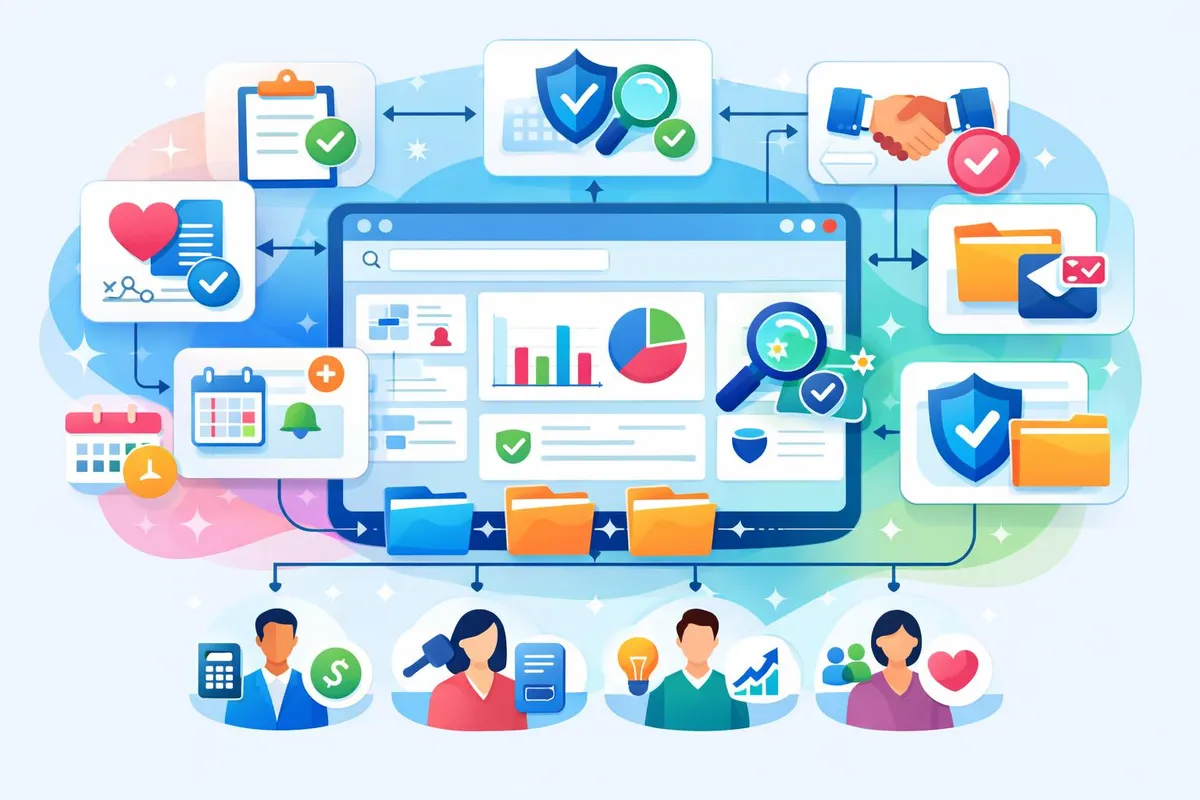
Nonprofit agreements don’t fail because teams don’t care—they fail because obligations get buried in inboxes, shared drives, and “someone knows where that file is.” When nonprofit contract management is fragmented, the consequences show up fast: missed grant reporting deadlines, restricted funds spent incorrectly, unsigned volunteer waivers, and avoidable audit stress.
This post breaks down a practical approach to managing grant agreements, donor restrictions, volunteer documentation, vendor contracts, and partnership terms in one connected system. You’ll learn why nonprofits need a different contract workflow than most businesses, what “compliance-ready” looks like in day-to-day operations, and how centralized tools (including AI-assisted review and automation) can help your team scale without increasing risk.
Why nonprofits need a different contract management model
Nonprofits manage a mix of agreements with very different risk profiles, including government grants, foundation funding, donor restrictions, volunteer waivers, vendor contracts, and partnership MOUs. Each category carries its own rules around approvals, documentation, privacy, procurement, and reporting. When those terms live in separate systems, your organization ends up relying on spreadsheets and institutional memory to stay compliant.
Additionally, contract obligations rarely sit in one department. Development tracks donor commitments, finance monitors allowable costs, legal reviews terms, and program teams own deliverables. A centralized approach turns each agreement into an active compliance record—connected to funding sources, internal policies, and deadlines—rather than a static PDF buried in a folder.
“Treat contracts as living compliance records, not archived documents—and you reduce missed obligations before they become audit findings.”
Grant agreements typically carry the highest operational risk because they define how funds can be used and what outcomes must be documented. Although nonprofits often use “grants” and “contracts” interchangeably, the distinction matters: funding tied to specific deliverables and controlled outputs often functions like procurement, while mission-support funding can be more flexible. In practice, both create binding obligations that require consistent tracking.
For instance, a typical grant agreement includes approved activities, budget restrictions, payment schedules, reporting requirements, audit rights, and termination clauses. Government-funded grants can add procurement standards, subrecipient monitoring obligations, and records-retention requirements. Missing just one condition can lead to repayment demands, delayed renewals, or increased scrutiny from funders.
Managing grants, donor restrictions, and volunteer agreements with less risk
The fastest way to reduce exposure is to standardize how agreements move from drafting to signature. Structured workflows ensure legal, finance, and program stakeholders review terms before execution, rather than after spending begins. Automated approval routing through contract workflow tools also reduces delays, while making it easier to demonstrate who approved what and when.
Centralization matters just as much as workflow. When agreements are scattered across email threads and disconnected folders, audits and renewals become stressful scavenger hunts. A dedicated repository with searchable tagging makes it easier to connect contracts to grant deliverables, donor restrictions, reporting deadlines, and supporting documentation. Systems with built-in contract management capabilities can also extract key terms like expiration dates, renewal windows, and compliance obligations.
Donor agreements add a second layer of accountability because large gifts, endowments, and restricted donations can include legally enforceable conditions around program use, geography, timing, or stewardship reporting. However, problems arise when development and finance operate from different “sources of truth.” If restrictions live only in a development system and aren’t connected to budgets and vendor contracts, your team can accidentally misallocate restricted funds.
For example, a major donation restricted to youth programming in a specific region can be spent incorrectly if the restriction is not linked to operational purchasing and internal approvals. Effective contract management ties donor terms directly to spending controls and reporting schedules, so the restriction is visible where decisions are made.
Volunteer documentation is another area where risk often hides in plain sight. Without signed agreements and waivers, you may struggle to enforce confidentiality, demonstrate safety acknowledgments, or clarify that volunteers are not employees. Standardizing templates for volunteer agreements, releases for higher-risk activities, and media permissions reduces inconsistencies across programs and lowers administrative burden.
In contrast to manually editing older files, AI-assisted drafting can help teams maintain approved language across frequently used documents, including volunteer agreements, consultant contracts, MOUs, and NDAs. With centralized templates, controlled versioning, and approval logic, you reduce “document drift” that can introduce conflicting terms over time.
Building a compliance-ready system for audits, subrecipients, and vendors
Compliance becomes operational when your organization can see obligations before they become emergencies. Funders increasingly expect nonprofits to demonstrate strong internal controls and documentation practices, not just impact. That means tracking reporting deadlines, grant milestones, procurement requirements, renewal dates, insurance obligations, and subrecipient oversight responsibilities in a way that scales as funding grows.
Subrecipient monitoring is a common breaking point. Once you pass grant funds downstream, you often inherit responsibility for ensuring those funds are used properly. Sub-award agreements need to incorporate the original grant requirements, including reporting obligations, audit access, and allowable-cost rules, and you need ongoing visibility into each partner’s deliverables and timelines.
Vendor agreements funded through grants also require extra care, especially under public funding rules. Procurement standards can require competitive bidding documentation, conflict-of-interest controls, and evidence of price reasonableness. When vendor contracts are linked back to the underlying grant, it becomes far easier to demonstrate compliance during reviews or audits.
- Centralize all agreements and supporting documents in one searchable repository tied to grants, donors, departments, and restriction categories
- Standardize templates and enforce role-based approvals so legal, finance, and program leaders review the right terms at the right time
- Automate reminders, renewal windows, and reporting deadlines so obligations are tracked proactively rather than after the fact
Approval governance is where process meets accountability. Many nonprofits set signing authority thresholds where larger or higher-risk agreements require executive or board approval, but issues arise when policies exist informally and don’t show up in day-to-day workflows. Automated routing helps enforce authority consistently and reduces bottlenecks without relying on manual email trails.
Reporting and visibility matter at the leadership level too. Contract reporting dashboards can surface upcoming grant expirations, restricted funding exposure, renewal opportunities, and outstanding obligations across departments, without manually consolidating spreadsheets. That shared visibility also improves collaboration across legal, finance, development, operations, and program leadership.
Integrated platforms can connect drafting, review, storage, workflows, and reporting into one environment. For example, ClearContract combines AI-powered review, centralized agreement storage, automated workflows, and searchable reporting tools that help teams review contracts, extract critical terms, automate reminders, and maintain audit-ready documentation from one platform. If you want to explore this approach, start at nonprofit contract management and evaluate which workflows you can standardize first.
Key Takeaways
Better contract management protects mission delivery by reducing compliance risk across grants, donor restrictions, volunteers, vendors, and partners. Your biggest wins come from making obligations visible, enforceable, and easy to retrieve when auditors, funders, or leadership ask questions.
Focus on (1) centralizing agreements in a searchable repository, (2) linking each contract to its funding source and restriction rules, (3) standardizing templates and approval workflows, (4) tracking reporting obligations and renewal deadlines proactively, and (5) improving cross-team visibility so legal, finance, development, and program staff work from the same record.
Next step: identify one high-risk area—often grant reporting, donor restrictions, or subrecipient oversight—and document the workflow from intake to renewal. Then consider how AI-assisted review and automation can reduce repetitive work while improving consistency. If you’re evaluating tools, explore how ClearContract’s AI contract review, workflow automation, and contract management features can support grant compliance and operational efficiency.