

Contract Language Best Practices for Clear Deals
 Jørgen Højlund Wibe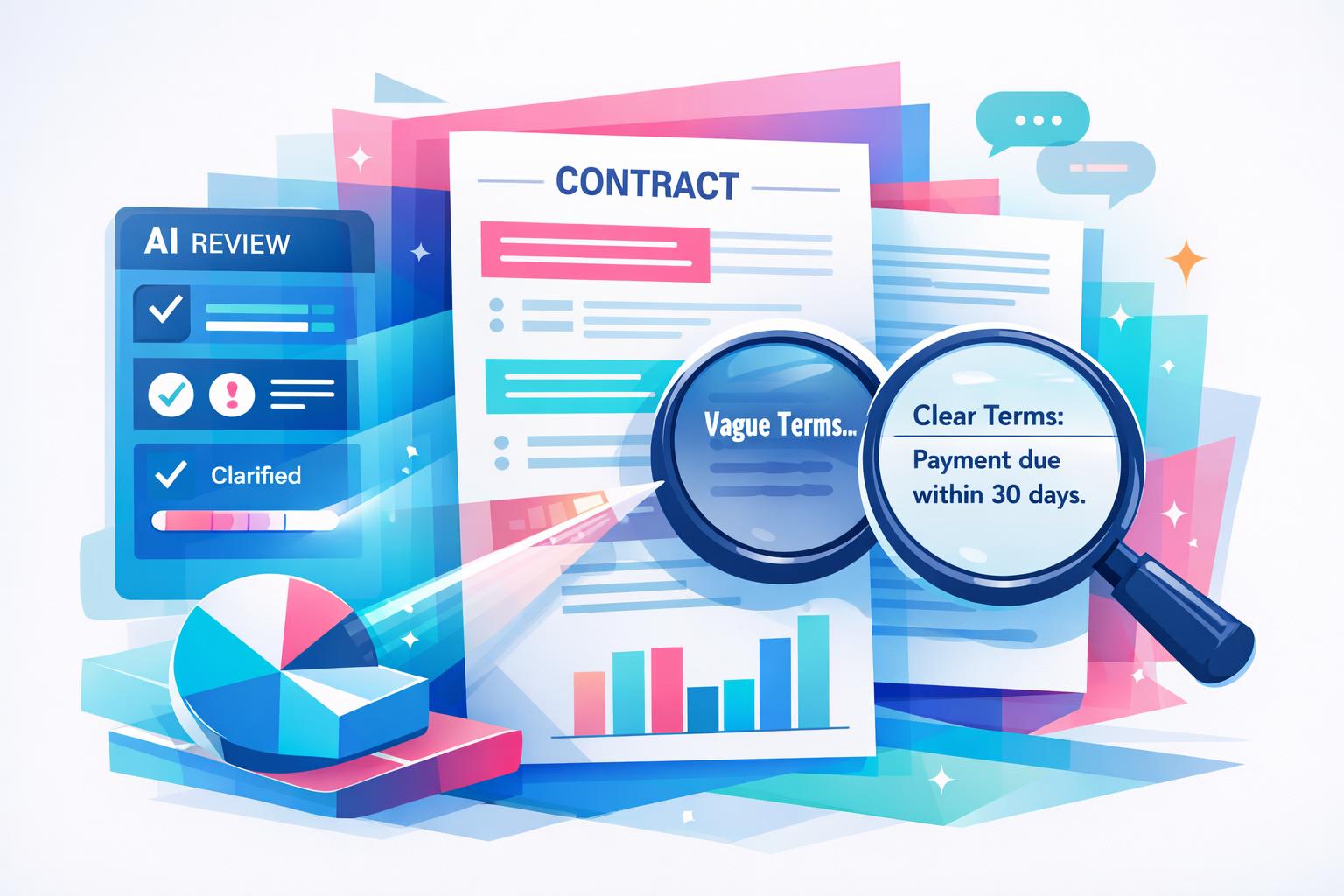
Most contract disputes don’t start with bad intent—they start with a sentence that can be read two different ways. If you manage agreements at scale, that ambiguity quickly turns into slower reviews, tougher negotiations, confused business users, and expensive leverage when something goes wrong. This post covers practical contract language best practices that help you draft clearer, more enforceable deals without trying to “sound legal.” You’ll learn how to spot common sources of ambiguity, how to define key terms without overcomplicating the document, and how Plain language and structure make obligations easier to follow in real life. Along the way, we’ll also show where modern tools can help you reinforce clarity across templates and large contract portfolios.
Avoid ambiguity with clear, consistent drafting
Ambiguity is the biggest enemy of clarity because it gives both sides a plausible story about what the contract “really” means. A useful standard is simple: each sentence should support only one reasonable interpretation. When your templates travel across teams, business units, and jurisdictions, small drafting habits compound into measurable risk.
Start by reducing vague, subjective phrases, including “reasonable efforts,” “as soon as possible,” or “industry standard.” These terms feel practical during negotiation, but they often become the battleground later. Instead, anchor obligations to observable facts, such as defined timelines, specific actions, resourcing expectations, or escalation steps that make performance measurable.
Additionally, treat consistency as a drafting rule, not a style preference. Switching between “Customer” and “Client,” or “Agreement” and “Contract,” can create interpretive gaps you never intended. In contrast to ordinary writing, repetition in contracts is a feature: once you choose a defined term, use it the same way everywhere, including capitalization.
Pronouns and references also hide ambiguity. If “it,” “they,” or “them” could point to more than one noun, repeat the noun. The same goes for cross-references: even if your agreement must point to other sections, each clause should still read cleanly without forcing the reader to bounce around the document to grasp the basic obligation.
Use active voice to keep responsibility unmistakable. “The Supplier shall deliver the Services” names the actor and the duty, while passive constructions blur accountability and invite arguments over who owned the task. Shorter sentences reinforce this by keeping the subject, verb, and object close together—especially in clauses with conditions and exceptions.
“Disputes rarely start because someone planned to breach—they start because the contract allowed two reasonable interpretations of the same sentence.”
Finally, clarity depends on structure, not just sentence-level edits. Long provisions stuffed with layered conditions, carve-outs, and exceptions are easy to misread and hard to enforce. Break complex logic into clean subsections so the relationship between the rule, the exception, and the consequence is obvious on a first pass.
If you review contracts at speed, tooling can support this discipline. For example, AI-powered contract review tools like ClearContract’s review feature can scan agreements for vague terms, inconsistent usage, and structural friction points that are easy to miss when you’re handling volume.
Define key terms and use plain language that holds up under pressure
Clear definitions are one of the most effective ways to prevent disputes because they reduce ambiguity across the entire agreement. This matters even more when contracts are reused, amended, or negotiated repeatedly, where small interpretive differences turn into repeated friction across deals.
Define terms that carry special meaning in your deal, that readers may interpret differently, or that appear frequently. For instance, commercial concepts such as “Services,” “Deliverables,” or “Net Revenue” often require precision, as do operational concepts such as “Business Day,” “Affiliate,” or “Confidential Information.” Not every word needs a definition, and over-defining can make the agreement harder to use.
Keep definitions disciplined: state what the term means without burying obligations or exceptions that belong in performance clauses. Overloaded definitions may look efficient, but they slow negotiation and make enforcement harder because the real rule is hidden where no one expects it. Furthermore, once a term is defined, use it exactly as defined and avoid synonyms even if repetition feels awkward.
Pro Tip: If a definition is doing “double duty” by sneaking in timeframes, remedies, or approval steps, move those rules into the operative clause and keep the definition purely descriptive.
Plain language reinforces enforceability because it reduces misunderstanding during performance, not just during negotiation. Archaic phrases, double negatives, and unnecessary formality slow readers down and raise the odds of misinterpretation. In many cases, concise wording is safer than redundancy like “any and all,” which adds length without reliably adding meaning.
At the document level, structure should follow a logical narrative: parties and scope first, then commercial terms and performance, then risk allocation and boilerplate. Grouping related clauses reduces accidental conflicts across sections and makes it easier for business users to find the “working rules” they need day to day.
If you support high contract volume, consistency becomes a systems problem as much as a drafting problem. With centralized contract management systems, teams can standardize definitions, templates, and clause structure rather than reinventing language for each deal. ClearContract’s contract management platform helps maintain a single source of truth for approved language and track how it evolves over time.
The payoff is most obvious when something breaks. Clear scope reduces arguments about what was included, objective performance standards make compliance easier to assess, and precise payment terms narrow disputes over timing and calculation. Even in mediation, arbitration, or court, disciplined drafting leaves far less room for decision-makers to speculate about intent.
Treat clarity as a repeatable process: vetted templates, internal reviews, and feedback from business users help you find language that confuses people in practice. AI-assisted drafting and review can accelerate this learning loop by surfacing patterns across large portfolios, and ClearContract’s automated contract drafting features and legal assistant are designed to support continuous improvement without adding friction to legal teams.
Key Takeaways
- Aim for one meaning per clause by replacing subjective standards with observable timelines, actions, and responsibilities.
- Define key terms that carry deal-specific meaning, keep definitions clean, and use defined terms consistently throughout the agreement.
- Use plain language, active voice, and logical structure so business users can follow obligations during performance, not just during negotiation.
- Standardize templates and clause structure to prevent drift across teams as contract volume grows.
- Consider tools that systematically flag ambiguity and enforce consistency, rather than relying only on manual review.
Next, review a handful of recent agreements and identify where ambiguity appears most often—scope, timing, effort standards, or payment mechanics are common culprits. Then, tighten those clauses in your templates and reinforce the changes through review workflows and centralized management. If you want to see how this works in practice, you can book a ClearContract demo or explore the platform directly by creating an account.
Related Reading
Revisit Contract Language Best Practices for Clear, Enforceable Deals to share with stakeholders who influence templates, approvals, and negotiation playbooks.