

Construction Contract Types Guide for Contract Management
 Jørgen Højlund Wibe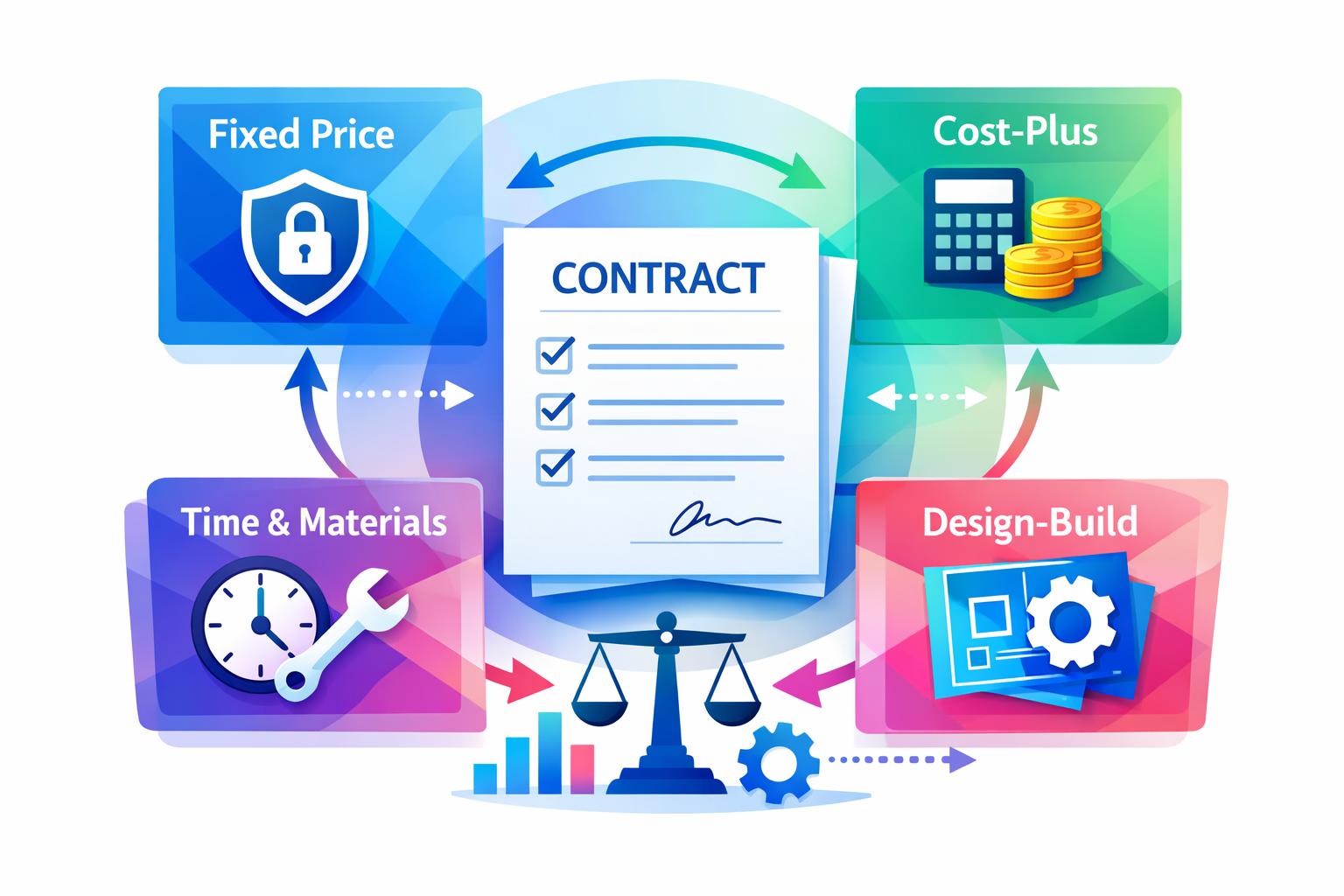
The contract type you choose at the start of a project quietly decides how the job will feel six months later—calm and predictable, or flexible but constantly monitored. Picking among construction contract types isn’t just about payment mechanics; it sets expectations for risk, change orders, documentation, and how disagreements get resolved when reality diverges from the plan.
In this guide, you’ll see how fixed price, cost-plus, time and materials, and design-build contracts work in practice, where each shines, and what trade-offs to plan for. You’ll also learn why disciplined drafting and change management matter in every model—and how modern platforms, including ClearContract’s AI and workflow tools, help keep evolving agreements under control.
How the four main construction contract types work in real projects
At a high level, contract structures trade off price certainty against flexibility. The more you lock in early, the more risk shifts to the contractor and the more you pay for contingencies and tighter change-order boundaries. In contrast, more flexible models can start faster and absorb uncertainty, but they require closer oversight and clearer definitions of what “cost” includes.
A fixed price (often called lump sum or stipulated sum) contract sets one total price for a defined scope. It works best when drawings and specifications are complete and site conditions are predictable, because the contractor can price the risk and execute with fewer surprises. However, once construction starts, changes tend to be expensive, and ambiguities in the documents often turn into disputes about what was “included.”
A cost-plus contract reimburses actual project costs and adds an agreed fee for overhead and profit, such as a fixed fee, a percentage, or a fixed fee paired with a guaranteed maximum price (GMP). This model is common when scope is evolving or when construction must start before design is finished, because it supports a collaborative, fast-moving approach. The trade-off is reduced upfront certainty, so you need disciplined invoice review and clear definitions of reimbursable costs.
A time and materials (T&M) contract typically pays agreed labor rates plus the actual cost of materials, often with markup built into the rates. It’s common for repairs, investigations, and service work where scope cannot be estimated credibly in advance. Unless you pair it with a not-to-exceed cap and active oversight, it delivers speed and adaptability at the cost of predictability.
A design-build contract changes accountability more than it changes pricing: the owner hires one entity responsible for both design and construction. Design and construction can overlap, which can shorten schedules and reduce coordination friction between designer and builder. However, you give up some direct control over detailed design unless performance criteria, review rights, and reporting expectations are carefully defined.
“No matter which model you choose, the contract becomes a living document—your outcome depends on how well you manage change, approvals, and scope clarity over time.”
Because the document keeps evolving, early review matters. Tools like ClearContract’s AI-powered contract review can help you catch missing clauses, unclear risk allocations, and inconsistencies before they turn into change-order friction or claims.
How to choose the right contract type for scope, schedule, and risk
In practice, your decision comes down to three questions: how defined the scope is today, how much cost certainty you need for financing or internal approvals, and how much flexibility you can tolerate once work begins. When the design is complete and coordinated, fixed price often feels cleanest because it simplifies budgeting and reduces day-to-day administrative burden.
That simplicity only holds if the documents are high quality. Even small gaps in drawings or specifications can create disagreements over what the contractor priced and what should be treated as a change. A centralized system helps you preserve the record of what was agreed, which is why teams lean on tools like ClearContract’s contract management features to keep agreements, attachments, and amendments controlled and easy to reference.
When scope is uncertain—or you need to fast-track—cost-plus or T&M can be more realistic. For example, if you’re starting early packages before design is fully complete, these structures can keep the schedule moving while details catch up. However, the contract must define reimbursable costs, documentation standards, and notice requirements, and you need governance strong enough to enforce them.
Workflow discipline is where many projects leak money, especially around approvals and caps. Automated reminders and routing reduce the chance that a not-to-exceed limit, reporting duty, or owner authorization step gets missed, which is why teams adopt tools like contract workflows to keep decisions timely and auditable.
Design-build adds another layer: you’re choosing an integrated delivery method with a single point of responsibility, often to gain speed and reduce coordination disputes. The key is converting performance goals into enforceable contract language so you’re protecting quality and budget expectations without relying on prescriptive design control. That typically means more emphasis on risk allocation clauses and reporting obligations, not just design details.
Pro Tip: If you’re using a flexible model (cost-plus or T&M), treat cost definitions and documentation rules as “scope” in their own right—then enforce them with consistent approvals and reporting from day one.
Across all models, better drafting and reuse of proven clauses reduces surprises. AI-assisted standardization helps legal and project teams spot risk patterns and keep templates current, which is the value proposition behind ClearContract’s automated drafting tools when you need to generate project-specific agreements without starting from scratch.
Key Takeaways
- There’s no universal best choice: fixed price, cost-plus, T&M, and design-build each solve different problems depending on scope clarity, risk appetite, and schedule pressure.
- Price certainty and flexibility sit on a spectrum: locking in a price pushes more risk to the contractor and can increase upfront cost, while flexible models demand stronger owner oversight and governance.
- Design-build primarily changes accountability by creating a single point of responsibility; it works best when performance requirements and review rights are clearly defined.
- Strong contract management is non-negotiable in every model: consistent review, clear drafting, and disciplined change control are what keep projects aligned as conditions shift.
If your organization is reassessing how it selects and manages construction contracts—or you’re planning a project where the contract type is still open—consider modern tools that make review, approvals, and obligations easier to run at speed. A practical next step is to explore ClearContract by booking a demo or creating an account to see the workflows in action.
Related Reading
Continue exploring this topic with Construction Contract Types Explained for Modern Projects, and consider how your contract selection connects to your internal review and approval process.