AI Liability in Contracts and Practical Risk Allocation
 Jørgen Højlund Wibe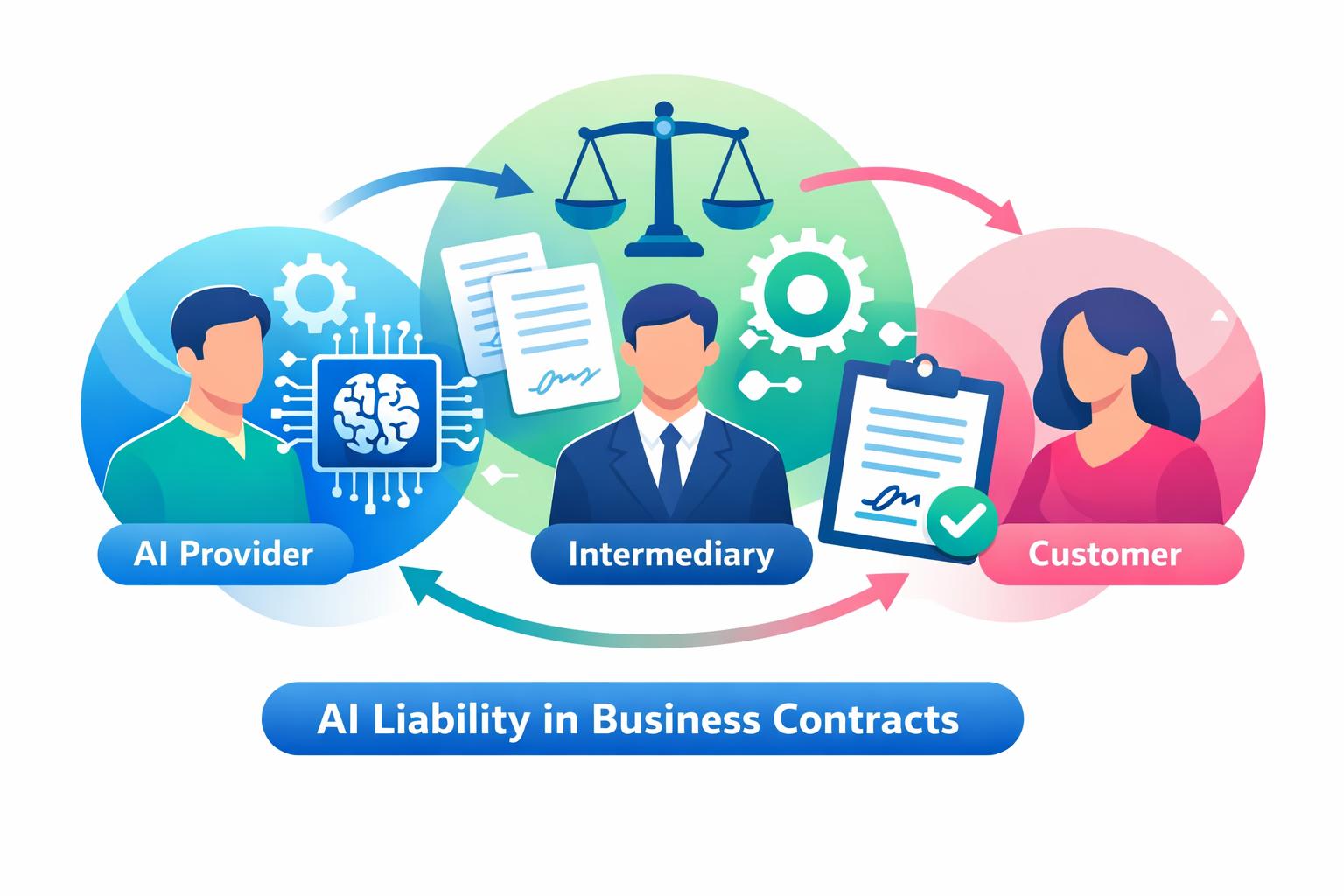
AI is now embedded in everyday business workflows, including contract review, decision support, and automated drafting. When something goes wrong, the real issue isn’t whether AI made the mistake—it’s how AI liability in contracts is assigned between the humans and organizations behind the system. This post explains how liability is typically allocated across providers, customers, and intermediaries; why product liability and regulation are increasing pressure on standard contract terms; and why the “AI is the product” versus “AI is used behind the scenes” distinction can decide who pays. You’ll also see the contractual safeguards that matter most when AI touches legally sensitive work, and what practical steps you can take to reduce disputes.
How AI liability is allocated today (and why “control” is the deciding factor)
AI never bears responsibility on its own because legal systems do not recognize AI as a legal person. Instead, courts and regulators typically look for who had meaningful influence over the outcome—who designed the system, who trained it, and who chose to rely on it in a real business context. In practice, that often spreads responsibility across the AI value chain rather than pointing to a single “fault” party.
Providers and developers face higher exposure when harm traces back to design choices, training data, or a failure to warn about known limitations. For instance, if a model is marketed as reliable for contract analysis but is trained on biased or unlawful data, or it routinely fails in predictable edge cases, liability risk increases under familiar software and product-liability-style theories adapted to probabilistic tools.
Customers and operators carry responsibility for deployment decisions, including whether you put human review in place, follow usage instructions, and avoid using AI in high-risk workflows without safeguards. That’s why many vendor terms emphasize that you remain responsible for final decisions and downstream outcomes, especially when your team acts on AI outputs without meaningful oversight.
Intermediaries, including integrators and platform providers, can also be pulled into disputes when they configure tools, combine multiple systems, or present AI outputs as part of a broader service. In complex supply chains, liability questions often turn less on abstract arguments about AI and more on practical contract mechanics like flow-down obligations, indemnities, and who controlled logging and configuration.
“What matters most is not whether AI was involved, but who had meaningful control at each stage.”
Product liability and regulation: why contracts can’t shift all the risk
A second layer of exposure comes from how AI is classified: as a product, a service, or something in between. That distinction matters because product liability regimes can impose strict liability for defects, regardless of fault. If AI is treated as a product, concepts like design defects and failure to warn become central, even though AI behavior is probabilistic rather than deterministic.
Continuous learning and frequent updates complicate causation. An error might stem from the original model, a later patch, or customer-supplied data used for tuning. As a result, AI contracts increasingly spend time on update rights, change management, and responsibility for retraining, because those operational choices often determine where risk lands when outcomes shift over time.
In Europe, proposed reforms aim to lower the evidentiary burden for claimants harmed by AI-driven outcomes. New rules are expected to make it easier to access system logs and, in some cases, to presume causation unless providers can show otherwise. Even when these rules target non-contractual liability, they still affect vendor negotiations because they limit how far parties can credibly disclaim responsibility in practice.
Pro Tip: Treat liability caps and disclaimers as a backstop, not the plan. Regulators and courts increasingly expect governance measures like logging, documentation, and review steps that match the risk level of the workflow.
Where contracts succeed or fail: the “AI as product” split, drafting errors, and safeguards that hold up
One of the most important distinctions is whether the AI system is what you’re buying, or whether AI is simply used to perform an existing obligation “behind the scenes.” If you purchase an AI-powered SaaS tool, providers often have more room to limit liability for occasional errors, as long as limitations are clearly explained and you have realistic ways to manage risk. In contrast, if you promise a standard of performance—such as careful contract review or compliant decision-making—liability usually does not shift just because you used AI internally to deliver the service.
That distinction is especially relevant for legal and commercial teams using AI in contract work. Tools can accelerate drafting and review, but they do not replace professional judgment, and courts are likely to ask whether your reliance on the output was reasonable and whether adequate human review happened before signing. Platforms like ClearContract are designed around this reality, combining AI-powered contract review tools with structured oversight so responsibility remains clear and defensible.
When disputes do happen, the clauses that matter most tend to focus on clarity and process rather than sweeping disclaimers. Well-structured agreements repeatedly return to expectations, oversight, and evidence—because those determine whether an AI error stays a contained issue or becomes an expensive, hard-to-prove argument about what the system “should” have done.
- Clear descriptions of what the system does, intended use cases, and known limitations, so expectations are anchored early.
- Human-in-the-loop requirements for high-impact decisions, including meaningful review before outputs are acted upon.
- Limitations of liability tied to fees paid, with negotiated carve-outs for data protection failures, IP infringement, or willful misconduct.
- Targeted indemnities for third-party risks, including IP claims or regulatory penalties caused by provider failures.
- Audit, logging, and cooperation clauses that preserve evidence if something goes wrong.
These safeguards also shape day-to-day behavior. When your agreement requires logging, review, and escalation, you reduce the chance that AI errors quietly propagate into broader disputes. ClearContract’s contract management platform supports this approach by centralizing agreements, tracking obligations, and maintaining audit trails around AI-assisted actions, which often matters as much as the liability clause wording.
Drafting and review errors deserve special attention because they sit at the intersection of automation and legal consequences. If AI drafts or edits a clause and something material goes wrong, traditional doctrines like mistake, misrepresentation, and rectification still apply, regardless of whether a human or a machine typed the words. Tools like ClearContract’s automated contract drafting features and integrated legal assistant reduce that risk through guided questionnaires, version control, and tracked changes that preserve accountability.
Key Takeaways
First, AI never “owns” the mistake—liability attaches to the people and organizations who design, deploy, and rely on the system. Second, allocation usually follows control, so your configuration choices and review practices can shift outcomes as much as vendor terms do. Third, product liability concepts and European regulatory changes make evidence, transparency, and logging more important over time. Finally, the most defensible approach is treating AI as a tool supported by human oversight, with contracts that require clarity, audit trails, and escalation paths.
Next, map where AI influences decisions or documents with legal or financial impact, then align vendor terms and internal policies to match your downstream obligations. If AI already plays a role in your workflow, review how AI liability in contracts is addressed across your agreements and ensure your processes can actually prove compliance when challenged.
Related Reading
Revisit this guide at AI Liability in Contracts: Who Bears the Risk when you’re negotiating AI vendor terms or updating internal review policies.