Build a Contract Risk Scoring Model With AI Automation
 Jørgen Højlund Wibe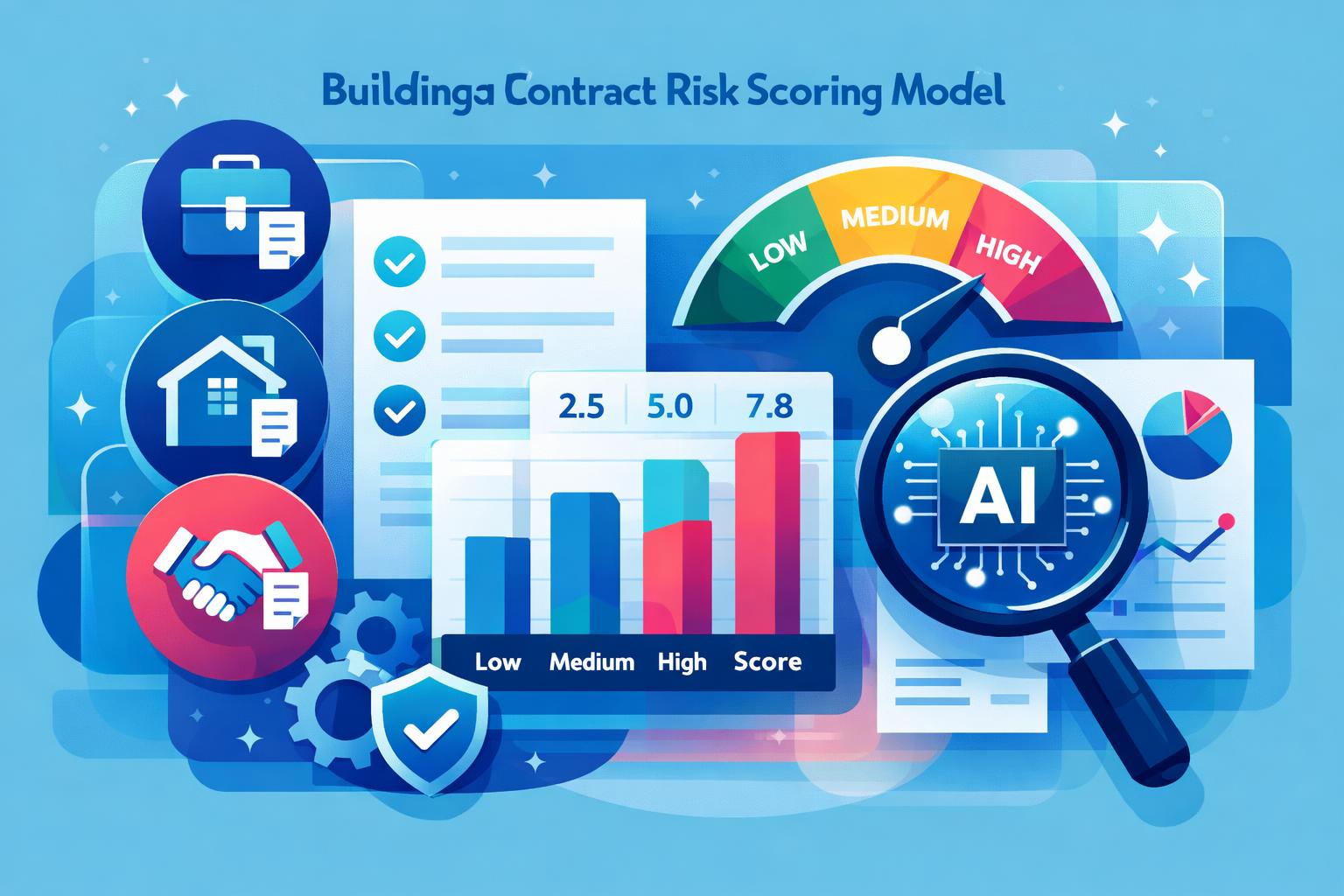
Introduction
Building a contract risk scoring model enables legal and business teams to systematically evaluate and mitigate contractual risks. This guide walks you through identifying risk categories, developing weighted scoring criteria, testing your model, and automating assessment with ClearContract’s AI Contract Review module — part of an autonomous legal department where AI does the work, not just talks about it. By the end, you’ll be ready to design a scalable, consistent risk model that supports strategic decision-making.
What You’ll Need
- Sample or historical contracts
- Agreed risk categories (financial, compliance, liability)
- Spreadsheet skills (Excel or Google Sheets)
- Input from legal, finance, and business stakeholders
- Estimated design time: 1–2 weeks manually or 3–5 days with AI Agents
Step 1: Identify Contract Risks
Start by defining what you are scoring—each risk factor that affects the contractual relationship. This initial step establishes the framework for consistent evaluation.
- Classify each contract by type, value, duration, and regulatory context.
- Review contracts using a standardized checklist covering financial terms, performance obligations, and liability clauses.
- Evaluate contextual risks such as counterparty stability and governing law.
💡 Pro Tip: Maintain a simple risk register in a spreadsheet or in ClearContract’s Contract Management module to record all identified risks.
Step 2: Score Likelihood and Impact
Assign numeric values to measure how probable and serious each risk is. These base scores form the foundation for your weighted model.
- Rate likelihood (chance of occurrence) from 1–10.
- Rate impact (potential damage) from 1–10.
- Compute risk using
Risk Score = Likelihood × Impact.
= B2 * C2Simple Excel example to multiply likelihood and impact values.
Use a risk matrix to visualize scoring levels—green for low, yellow for medium, and red for high risk.
Step 3: Apply Weighted Risk Criteria
Balance different categories by assigning weights based on business priorities. Weighted scoring brings objectivity to the overall contract risk rating.
- Define categories and assign weights (e.g., Financial 40%, Compliance 30%, Liability 20%, Reputation 10%).
- Multiply each category score by its respective weight.
- Sum weighted results to get a composite contract risk score.
def calculate_risk_score(contract_data):
    weights = {
        'financial': 0.4,
        'compliance': 0.3,
        'liability': 0.2,
        'reputation': 0.1
    }

    total = 0
    for category, (likelihood, impact) in contract_data.items():
        total += likelihood * impact * weights[category]

    return round(total, 2)

data = {
    'financial': (7, 9),
    'compliance': (5, 6),
    'liability': (6, 8),
    'reputation': (3, 4)
}

print(calculate_risk_score(data))
Example Python function computing a weighted risk score.
Step 4: Set Risk Thresholds and Actions
Translate numeric scores into clear actions and approval flows in the Tasks & Deadlines module. Thresholds ensure consistent decision-making across teams.
- Define risk thresholds such as Critical (>70), High (50–70), Medium (30–49), and Low (<30).
- Document all risks, final score, recommended mitigations, and approval rationale.
- Store this record centrally for future audits and process reviews.
Step 5: Automate Risk Scoring With AI
Autonomous AI Agents streamline risk evaluation by scanning contracts at clause-level speed and accuracy, cutting review time by ~80%.
- Forward the contract to ClearContract’s Intake Agent via its dedicated email address.
- The Review Agent extracts clauses, compares them to your playbook, assigns risk scores, and flags deviations as tracked changes.
- Scores auto-update when contract language changes, enabling continuous risk management.
Step 6: Monitor and Report on Risk Over Time
Risk evolves throughout the contract lifecycle. Regular monitoring preserves your model’s accuracy and strategic usefulness.
- Recalculate scores on amendments, renewals, or policy updates.
- Review portfolio-wide metrics such as average risk per department and clause trends.
- Use ClearContract’s Reports & Analytics to visualize risk distribution and track remediation performance.
Step 7: Verify Your Model Works
Validation ensures the model produces reliable, consistent results. Test before senior-level deployment.
- Confirm similar contracts yield similar scores.
- Ensure high-risk contracts trigger required escalations.
- Test on at least 20–50 historical contracts to verify results.
Want a guided walkthrough? Book a ClearContract demo to see the full risk-scoring stack in action.
Common Issues & Solutions
- Scores feel subjective: Define scoring rules tightly and apply weighting consistently.
- Too many high-risk results: Rebalance category weights or refine thresholds.
- Model becomes outdated: Update benchmarks quarterly and revalidate scoring logic.
- Manual reviews take too long: Automate extraction and scoring with autonomous AI Agents.
Key Takeaways
- Structured risk scoring improves objectivity and repeatability.
- Weighted criteria reflect organizational priorities.
- Autonomous AI Agents enhance scalability and speed of analysis.
- Regular Reports & Analytics ensure continuous improvement.
- Integrate your model into Tasks & Deadlines for consistent compliance.