
Contract Risk Management Scoring Model with AI Automation
 Jørgen Højlund Wibe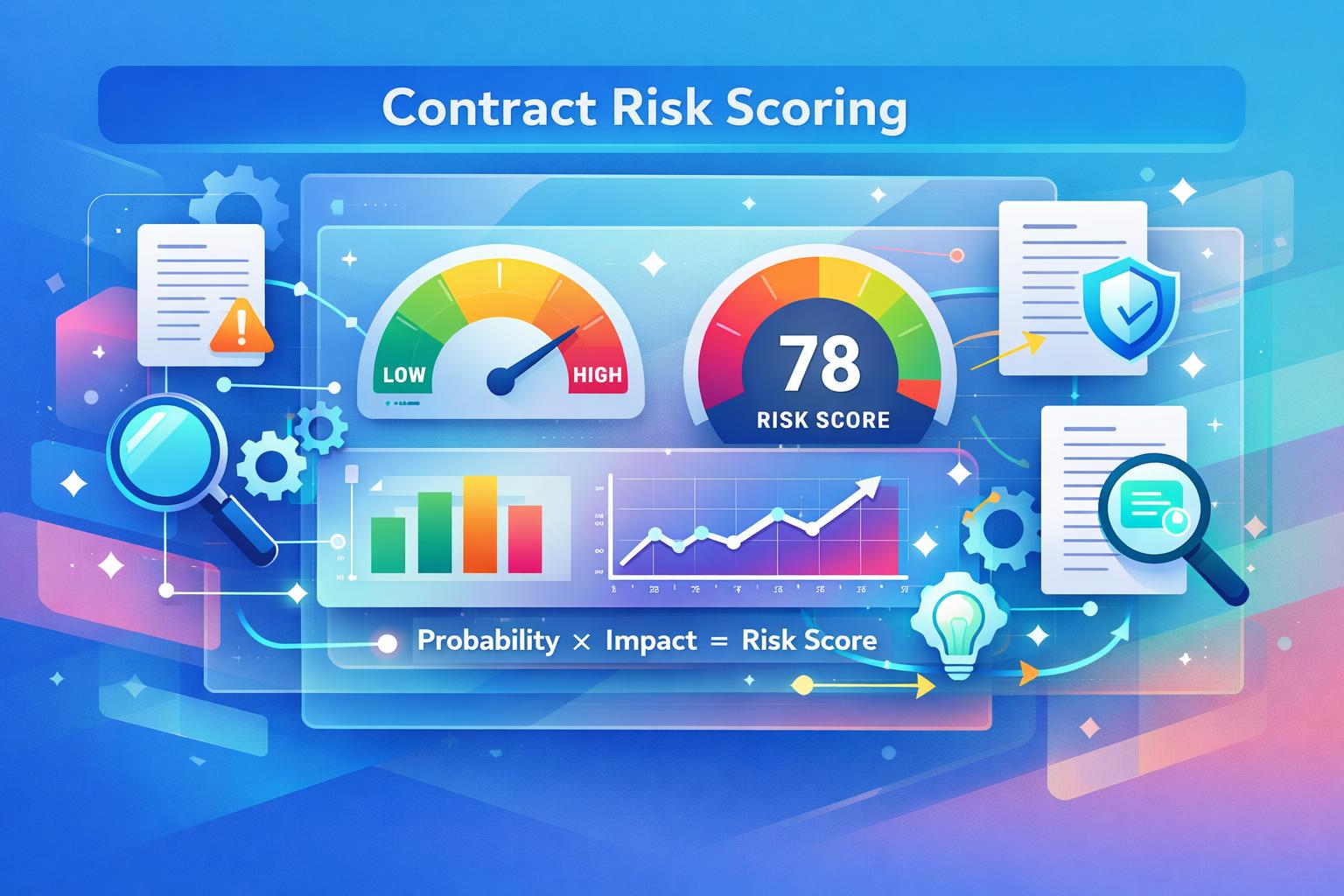
Introduction: Turning Contract Risk into Actionable Scores
This guide walks you through how to build a practical contract risk scoring model that converts legal uncertainties into measurable, numerical insights. You’ll learn to define weighted criteria, design scoring formulas, and automate the process using ClearContract’s AI Contract Review — part of an autonomous legal department where AI does the work, not just talks about it.
What You’ll Need
- Access to existing contracts (PDF, Word, or CLM repository)
- Input from legal, finance, compliance, and operations stakeholders
- Basic understanding of key contract clauses
- Optional: Excel, Google Sheets, or a Contract Management module like ClearContract
Step 1: Prepare and Classify Your Contracts
Start by organizing contracts into a structured repository so risk can be assessed in context. Classification helps ensure the scoring reflects the contract’s nature, scale, and purpose.
- Gather all contracts into a central repository for consistency.
- Classify each contract by type, value, industry/regulation, and duration.
- Mark which contract types represent higher inherent risk (e.g., high-value or long-term).
💡 Pro Tip: If you use a CLM or Contract Management module, configure the Intake Agent to auto-classify contracts and save time.
Step 2: Identify Contract Risk Factors
Pinpoint which risk areas to evaluate by reviewing recurring clause-level issues. Documenting these creates a uniform baseline for scoring.
- Use a standardized checklist to review contracts.
- Identify frequent risks such as unlimited liability, one-sided indemnities, or regulatory obligations.
- Document each risk as a clause-level item for traceability.
Step 3: Define Weighted Risk Criteria
Assign priority to what matters most by weighting categories. Weights help your model reflect organizational tolerance for various risks.
- Group risk factors into logical categories like financial, compliance, liability, performance, and reputation.
- Assign percentage weights (totaling 100%) to align with organizational priorities.
- Validate chosen weights with key stakeholders to reduce bias.
Example Weighting Model: Financial (30%), Compliance (25%), Liability (20%), Performance (15%), Reputational (10%)
Step 4: Score Individual Risks Using Probability × Impact
This formula measures how likely and how damaging a risk is, producing a clause-level numeric value.
- Assign Probability on a 1–10 scale, from unlikely to almost certain.
- Assign Impact on the same scale, from negligible to severe.
- Compute each clause’s score as
Risk Score = Probability × Impact.
Example: Unlimited liability clause — Probability: 7, Impact: 9, Resulting Risk Score: 63.
Step 5: Apply Weights and Aggregate Scores
Transform individual clause scores into an overall contract-level result. Weighted totals help rank contracts by overall risk exposure.
- Multiply each clause score by its corresponding category weight.
- Sum the weighted scores to get the total contract score.
- Normalize final results to a 0–100 scale for easy interpretation.
- Assign thresholds for low, medium, and high risk bands.
Step 6: Recommend Mitigation Actions
Connect the score output to specific actions so teams know how to respond to risk levels efficiently.
- Define clear responses for low, medium, and high-risk ranges.
- Document actions such as clause revisions or insurance requirements in a risk register.
- Integrate mitigation decisions into Tasks & Deadlines so approvals never get lost.
Step 7: Automate Risk Scoring with AI
Automation ensures accuracy and scalability by letting the AI Contract Review and Review Agent extract clauses, detect deviations, and apply scoring formulas in real time.
- Deploy the AI Contract Review module for clause extraction and deviation detection.
- Implement automated scoring rules using your predefined weights and thresholds.
- Enable dynamic rescoring for contract amendments or renewals via the Review Agent.
ClearContract cuts review time by roughly 80% — averaging 2 hours saved per contract — while improving consistency across teams.
Step 8: Monitor, Review, and Improve the Model
Treat your risk model as a living system. Regular reviews ensure it stays aligned with evolving business and regulatory changes.
- Review category weights and scoring thresholds each quarter.
- Compare scoring results against actual performance outcomes via Reports & Analytics.
- Adjust criteria and scoring logic based on emerging risk patterns.
Verification: Confirm Your Model Works
Evaluate model performance by comparing new risk scores with historical contract data and business outcomes.
- Similar contracts produce consistent risk scores
- High-risk contracts are flagged accurately
- Review time per contract decreases over time
- Stakeholders confirm scores align with real-world risk
Common Issues & Solutions
- Issue: Scores feel subjective – Solution: Refine scoring definitions and provide reviewer calibration training.
- Issue: Too many high-risk results – Solution: Adjust threshold ranges with historical contract data.
- Issue: Model becomes outdated – Solution: Implement quarterly review cycles and automatic rescoring.
Key Takeaways
- Use weighted criteria to prioritize contract risks objectively.
- Standardize scoring using Probability × Impact for clarity.
- Automate scoring with autonomous AI Agents to scale risk reviews efficiently.
- Recalibrate thresholds based on real contract outcomes.
- Integrate scoring and mitigation actions into Tasks & Deadlines and Reports & Analytics for continuous improvement. Book a ClearContract demo to see it live.